2026 Top Mini Circuit Breaker Types B C and D Compared
A Mini Circuit Breaker can look identical on the outside yet respond very differently when a motor starts. That difference matters. The IEA’s Electricity 2025 report recorded a 4.3% increase in global electricity demand during 2024. Growing electrical loads make protection choices increasingly consequential, especially where compressors, pumps, and electronic power supplies share distribution boards.
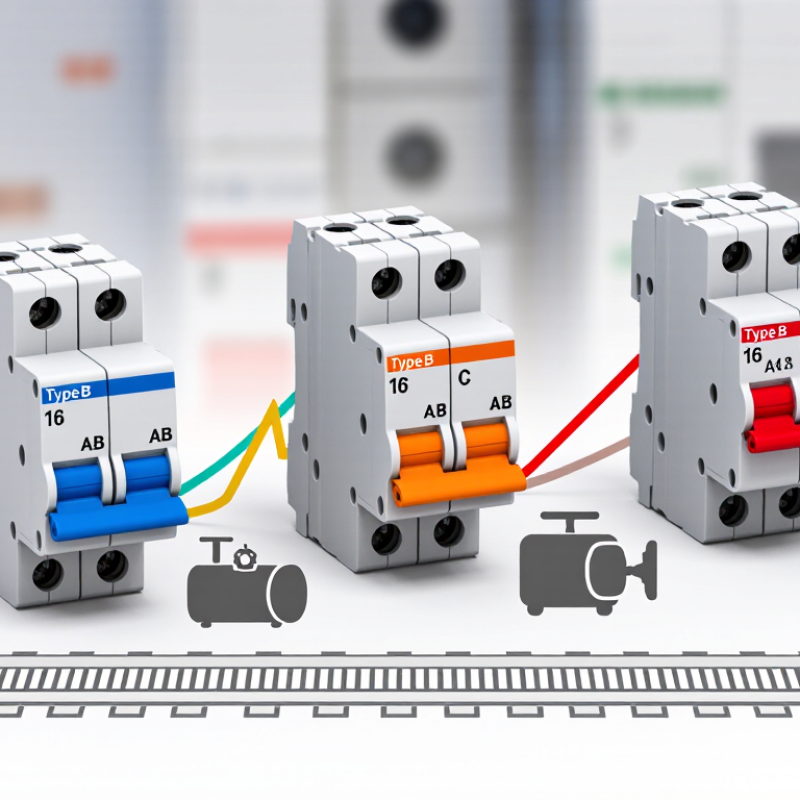
Under IEC 60898-1, Type B breakers have instantaneous tripping ranges of three to five times their rated current. Type C operates at five to ten times rated current; Type D operates at ten to twenty times. Consider three 16 A breakers: their respective magnetic operating bands are 48–80 A, 80–160 A, and 160–320 A. These are operating ranges, not exact trip points. Electrical educator and industry expert Mike Holt emphasizes conductor and equipment protection in his teaching on overcurrent devices. That principle matters when comparing trip curves: tolerating startup current must remain compatible with effective fault protection. Check the curve.
For 2026 buyers, Type B commonly suits low-inrush circuits, while Type C accommodates moderate startup surges. Type D can accommodate higher inrush, but requires careful verification of available fault current and disconnection requirements. A workshop compressor may suggest Type C, yet its actual starting current could challenge that assumption. Application labels are imperfect shortcuts. This comparison examines those practical limits, including nuisance tripping, cable protection, and manufacturer-specific curves. A seemingly successful upgrade deserves scrutiny if it stops unwanted trips while delaying necessary disconnection.
MCB Fundamentals: Type B, C, and D Curves Under IEC 60898-1
Under IEC 60898-1, Type B, C, and D miniature circuit breakers have different instantaneous magnetic tripping ranges. Type B operates at 3–5 times rated current, Type C at 5–10 times, and Type D at 10–20 times. These multiples describe rapid magnetic operation, while a thermal mechanism responds to sustained overloads. Inrush matters. A breaker’s current rating alone cannot show whether it will tolerate a motor starting or disconnect a fault quickly enough.
Type B commonly suits resistive loads and circuits with limited starting current, such as straightforward electric heating circuits. Type C accommodates moderate inrush from equipment such as small motors, provided circuit conditions support timely fault clearance. Type D can accommodate higher inrush, including some transformer applications, but requires particular attention to available fault current. Consider a 16 A breaker: its magnetic operating range is 48–80 A for B, 80–160 A for C, and 160–320 A for D. These are operating bands, not exact trip thresholds.
Choosing Type D simply because Type B trips during startup can leave the underlying problem unresolved and compromise fault protection. That deserves scrutiny. Selection requires checking the load’s starting characteristics, conductor capacity, prospective short-circuit current, and required disconnection time. Breaking capacity also matters: it must suit the prospective short-circuit current at the installation point. These fundamentals remain relevant in 2026; an application label such as “motor circuit” still leaves important installation details unanswered.
MCB SELECTION REFERENCE · 2026
2026 Top Mini Circuit Breaker Types B C and D Compared - MCB Fundamentals: Type B, C, and D Curves Under IEC 60898-1
Compare the standardized instantaneous tripping characteristics, shared thermal overload requirements, and typical application considerations for Type B, C, and D miniature circuit breakers. All values are brand-independent.
IEC 60898-1 characteristic comparison. In denotes the rated current of the circuit breaker.
Comparison Dimension
Type B
Type C
Type D
Instantaneous magnetic tripping band
3–5 × In
5–10 × In
10–20 × In
Lower magnetic test point
At 3 × In: must not trip within 0.1 s.
At 5 × In: must not trip within 0.1 s.
At 10 × In: must not trip within 0.1 s.
Upper magnetic test point
At 5 × In: must trip in less than 0.1 s.
At 10 × In: must trip in less than 0.1 s.
At 20 × In: must trip in less than 0.1 s.
Example magnetic band for a 16 A MCB
48–80 A
80–160 A
160–320 A
Relative tolerance of brief inrush current
Lower magnetic threshold; suited to loads with limited inrush.
Intermediate magnetic threshold; accommodates moderate inrush.
Higher magnetic threshold; accommodates higher inrush.
Typical application candidates
Resistive heating and circuits supplying loads with low starting current.
Small motors, some lighting circuits, and equipment with moderate starting current.
Transformers, motors, and other equipment with high starting or magnetizing current.
Fault current needed to ensure operation in less than 0.1 s under the standard test conditions
5 × In
10 × In
20 × In
Thermal overload characteristic
The same standardized thermal overload test requirements apply to B, C, and D curves. The letter primarily distinguishes the instantaneous magnetic tripping characteristic.
Conventional non-tripping current
1.13 × In: no trip during the conventional time, starting from cold under the specified test conditions. Conventional time is 1 hour for In ≤ 63 A and 2 hours for In > 63 A.
Conventional tripping current
1.45 × In: must trip within the conventional time after the prescribed 1.13 × In preloading sequence. Conventional time is 1 hour for In ≤ 63 A and 2 hours for In > 63 A.
Thermal test at 2.55 × In
Starting from cold: tripping time must be greater than 1 s and less than 60 s for In ≤ 32 A; greater than 1 s and less than 120 s for In > 32 A.
Reference ambient temperature
30 °C for the standardized time-current characteristic. Actual thermal behavior depends on ambient temperature, enclosure conditions, and adjacent loaded devices.
Short-circuit breaking capacity, Icn
Not determined by the B, C, or D letter. Check the device's marked breaking capacity against the prospective short-circuit current at its installation point.
Residual-current protection
An MCB alone does not provide residual-current protection. Where required, use an appropriate RCD or an RCBO that combines residual-current and overcurrent protection.
Type B MCBs: Magnetic Tripping at 3–5 × Rated Current
Type B miniature circuit breakers suit circuits with low starting currents, including many domestic lighting and resistive heating loads. Their magnetic release responds within a standardized band of 3–5 times rated current. IEC 60898-1 specifies this characteristic through controlled laboratory tests. For a 16 A breaker, the band corresponds to 48–80 A. That distinction matters. Under specified test conditions, the breaker must trip within 0.1 seconds at 80 A. At 48 A, instantaneous operation within that interval is not required.
The same standard separates magnetic protection from slower thermal overload protection. For ratings up to 63 A, its conventional thermal tests use a one-hour period. At 1.13 times rated current, the breaker must not trip during that period under specified conditions. At 1.45 times rated current, it must trip within the prescribed time. For a 16 A device, those test currents are 18.08 A and 23.2 A. Temperature still matters. These figures describe standardized tests; enclosure heat and adjacent loaded devices can affect actual operation.
Choosing Type B solely because a circuit serves a home is an imperfect shortcut. Several LED drivers switching together can produce substantial inrush, despite modest running current. Check their published inrush data. Compared with Type C at 5–10 times rated current, Type B requires less fault current for magnetic operation. However, cable capacity and fault-loop impedance still need verification, following applicable installation requirements such as IEC 60364. Repeated nuisance trips deserve investigation before selecting a different curve.
Type C MCBs: Magnetic Tripping at 5–10 × Rated Current
Type C miniature circuit breakers (MCBs) suit circuits with moderate startup surges, including small motors and grouped lighting loads. Their magnetic release operates within 5–10 times the rated current under specified test conditions. For a C16 breaker, that corresponds to 80–160 A. This is a range. It is not a single, exact trip point. A brief startup pulse may pass without tripping, depending on its magnitude and duration.
Under commonly used IEC 60898-1 characteristics, Type B has a 3–5× magnetic operating band, while Type D uses 10–20×. Type C sits between them, offering greater tolerance for startup current than Type B. However, its thermal element still responds to sustained overloads. Consider a workshop extractor that occasionally trips a correctly rated Type B breaker during startup. Type C might help, but the startup current and available fault current need checking. Guessing from motor size alone feels convenient; it leaves too much uncertainty.
Tips: Record the load current, startup duration, cable size, and circuit length before choosing a trip curve. Check the manufacturer’s time-current curve and verify the required disconnection time for the installation. Measure where possible. A long cable run can reduce fault current, potentially delaying magnetic operation. Changing from Type B to Type C therefore requires checking protection performance, even when the ampere rating stays unchanged.
Type D MCBs: Magnetic Tripping at 10–20 × Rated Current
Type D miniature circuit breakers suit circuits where startup current can briefly rise far above normal operating current. Their magnetic tripping band typically spans 10–20 times rated current under IEC 60898-1 characteristics. For a 16 A breaker, that corresponds to 160–320 A. This is a band. It is not one precise switching point. Compared with Type B at 3–5 times and Type C at 5–10 times rated current, Type D tolerates larger brief surges.
Consider a workshop motor drawing 16 A during normal operation but substantially more during startup. A Type D breaker may accommodate that brief surge, provided its duration fits the manufacturer's time-current curve. Duration matters. A sustained overload still activates the thermal trip mechanism, so Type D does not permit continuous overloading. Transformers and some motors are common candidates, although equipment labels alone cannot establish the correct breaker type. Actual starting current, cable capacity, and fault conditions require assessment.
The easy mistake
is treating Type D as a quick cure for repeated startup trips without checking the existing circuit. That assumption deserves scrutiny: frequent trips may indicate a stalled motor, excessive load, or another fault. Higher magnetic thresholds also demand sufficient fault current for rapid disconnection. On long cable runs, circuit impedance can limit that current. A qualified electrician should verify disconnection times, prospective fault current, and breaking capacity before selecting the device.
Selecting an MCB: Load Inrush, Fault Current, and Breaking Capacity
Selecting a miniature circuit breaker starts with the load’s startup behavior, not just its running current.
Under IEC 60898-1, Type B, C, and D magnetic tripping bands are typically 3–5, 5–10, and 10–20 times rated current. These bands describe instantaneous operation; the thermal element handles sustained overloads. A 16 A Type C breaker therefore has a magnetic tripping band of approximately 80–160 A. Check the duration, too. A brief LED-driver surge and a motor’s longer startup demand different assessments.
Type B
often suits resistive loads, while Type C accommodates moderate inrush from some motors and lighting circuits.
Type D
can accommodate higher inrush, but requires careful fault-current verification. Measure where possible.
Choosing Type D simply to stop nuisance trips can compromise required disconnection times when fault current is insufficient. I would question that shortcut before changing the curve. Cable length, conductor size, and supply impedance influence the fault current available at the load.
Breaking capacity answers a separate question: can the breaker safely interrupt the prospective short-circuit current at its installation point? A 6 kA rating does not describe normal load capacity or startup tolerance. If prospective fault current exceeds 6 kA, that rating alone is insufficient. Verify the applicable voltage rating, installation rules, and any documented backup protection arrangement. An estimated fault level may support preliminary selection, but it leaves uncertainty that needs resolving before installation.