Leave Your Message

10 Best Mini Circuit Breakers for Global Buyers

Choosing the right Mini Circuit Breaker requires more than comparing prices or product photographs. Global buyers must examine rated current, voltage, pole configuration, tripping curve, and interrupting capacity. These details affect safety inside homes, factories, control panels, and commercial buildings. A compact breaker may look suitable, yet its terminal design or heat performance can create problems during installation.

This guide reviews ten strong Mini Circuit Breaker options for international purchasing decisions. Each product should be checked against current technical documentation, test reports, and applicable regional requirements. DIN-rail compatibility matters when replacing equipment in an existing distribution board. Clear labeling matters too, especially when electricians work across language barriers. Some models offer thermal-magnetic protection, while others focus on specialized equipment or demanding environments. The best choice depends on the application, not only the brand name.

Practical sourcing also requires careful supplier evaluation. Buyers should request sample units, verify factory quality controls, and inspect markings before placing larger orders. Certification claims need confirmation from recognized testing organizations. Never rely on a copied certificate image. No ranking is perfect. Product availability, local approval, and after-sales support can change quickly. This review therefore combines technical comparison with realistic purchasing concerns, helping buyers identify dependable options while recognizing that one breaker cannot fit every electrical system.
10 Best Mini Circuit Breakers for Global Buyers

Mini Circuit Breakers: Definition, Structure, and Core Functions

A mini circuit breaker (MCB) is a resettable protective device for low-voltage circuits. It interrupts current when overload or short-circuit conditions become dangerous. The IEA’s Electricity 2024 report forecasts global electricity demand will grow by about 4% annually through 2026. This expansion increases demand for compact protection in homes, workshops, commercial panels, and control cabinets.

Inside an MCB, a bimetal strip responds to sustained overloads. It bends slowly and releases the trip mechanism. A magnetic coil reacts almost instantly to severe short circuits. The contacts separate, while an arc chute divides and cools the electric arc. The housing provides insulation, and the terminals secure conductors. Small parts, but not simple.

Core selection depends on rated current, voltage, pole count, tripping curve, and breaking capacity. IEC 60898-1 addresses MCBs for household and similar applications, while IEC 60947-2 applies to broader industrial equipment. A suitable device must match the cable’s allowable current, not merely the appliance label. That mistake remains common. IEA demand figures show a larger electrical market, but they do not guarantee safer installations. Actual temperature, enclosure space, fault current, and tightening torque still matter. A printed rating is only the starting point.

10 Best Mini Circuit Breakers for Global Buyers - Mini Circuit Breakers: Definition, Structure, and Core Functions

Rank MCB Configuration Profile Typical Pole Arrangement Typical Rated Current Typical Rated Voltage Trip Curve Typical Breaking Capacity Common Standards Typical Width Core Application
1 General-purpose residential MCB 1P 6–32 A 230/240 V AC B 6 kA IEC 60898-1 About 18 mm Lighting circuits, socket outlets, and small household loads with low inrush current.
2 Residential and light-commercial feeder MCB 1P+N 6–40 A 230/240 V AC B or C 6 kA or 10 kA IEC 60898-1 About 18 mm per pole Single-phase final circuits where both line and neutral conductors require coordinated switching.
3 High-inrush appliance MCB 1P or 1P+N 10–40 A 230/240 V AC C 6 kA or 10 kA IEC 60898-1 About 18 mm per pole Air conditioners, refrigerators, pumps, small compressors, and other moderate starting-current loads.
4 Motor-starting MCB 1P, 2P, or 3P 6–63 A 230/400 V AC D 6 kA or 10 kA IEC 60898-1 About 18 mm per pole Motors, transformers, welding equipment, and circuits with short-duration inrush current.
5 Three-phase distribution MCB 3P 6–63 A 400/415 V AC C 6 kA or 10 kA IEC 60898-1 About 54 mm total Three-phase machinery, small commercial distribution boards, and balanced three-phase loads.
6 Four-pole commercial MCB 4P 10–63 A 400/415 V AC C 6 kA or 10 kA IEC 60898-1 About 72 mm total Three-phase circuits requiring simultaneous switching of three line conductors and neutral.
7 High-capacity industrial MCB 1P, 2P, 3P, or 4P 10–100 A 230/400 V AC C or D 10 kA or 15 kA IEC 60947-2 About 18 mm per pole Industrial panels and distribution systems with higher prospective short-circuit current.
8 DC photovoltaic and battery MCB 1P or 2P 6–63 A Up to 500 V DC, depending on design Manufacturer-defined DC characteristic Typically 6 kA or higher IEC 60947-2 or IEC 60898-2, as applicable About 18 mm per pole PV strings, battery banks, and low-voltage DC distribution; polarity and DC rating must be verified.
9 Supplementary protection breaker 1P or 2P 0.5–32 A 120/240 V AC or 230/240 V AC B or C Typically 3 kA to 10 kA IEC 60934 or UL 1077, depending on market About 18 mm per pole Control circuits, instrumentation, electronic equipment, and protection downstream of a branch-circuit device.
10 North American branch-circuit miniature breaker 1P or 2P 10–60 A 120/240 V AC Thermal-magnetic; equivalent trip behavior varies Typically 10 kA RMS symmetrical UL 489 and applicable national installation codes Approximately 25 mm per pole, depending on design Residential and commercial branch circuits using North American load centers and panelboards.

Buyer’s note: Values shown are typical market ranges rather than universal specifications. Confirm the product datasheet, local wiring regulations, ambient-temperature derating, terminal capacity, mounting system, polarity requirements, and prospective short-circuit current before selection. IEC and UL classifications are not interchangeable.
Key Selection Criteria for Global Mini Circuit Breaker Buyers

10 Best Mini Circuit Breakers for Global Buyers

Key Selection Criteria for Global Mini Circuit Breaker Buyers

Global buyers should begin with the installation, not the product photograph. The International Energy Agency’s Electricity 2024 report forecasts global electricity demand to grow by about 3.3% annually from 2024 to 2026. More distributed loads mean greater attention to overload protection, fault levels, and future capacity. Check the rated current, voltage, frequency, pole arrangement, and breaking capacity. A 6 kA device may be unsuitable where the prospective short-circuit current reaches 10 kA.

More distributed loads mean greater attention to overload protection, fault levels, and future capacity.

Standards matter. IEC 60898-1 generally covers circuit breakers for household and similar installations, while IEC 60947-2 applies to many industrial applications. Confirm the correct standard before comparing prices. Then examine B, C, or D tripping curves. Curve C may suit common motor loads, but Curve D needs careful verification because it tolerates higher inrush current. Do not ignore temperature derating, altitude, terminal torque, conductor size, or AC and DC compatibility. Small details cause large failures.

A reliable supplier should provide test reports, conformity documents, drawings, and traceable production information. Certification alone is not enough. Field engineers still find mismatched terminals, incorrect torque, and crowded distribution boards. The overlooked detail? Installation practice. Ask for endurance data, short-circuit test conditions, and replacement availability across the target market. IEA data supports stronger grid investment, yet forecasts cannot reveal every local fault condition. A neat catalogue can still hide an incomplete selection.

Top Ten Mini Circuit Breaker Options by Application and Performance

10 Best Mini Circuit Breakers for Global Buyers

Top Ten Mini Circuit Breaker Options by Application and Performance

Choosing among mini circuit breakers starts with the application, not the price. A residential single-pole breaker suits basic lighting circuits, while a two-pole model protects line-to-line equipment. For socket circuits, select a unit with reliable thermal-magnetic protection and clear trip indication. Low-inrush lighting may need a sensitive curve, but small motors often require a slower curve to prevent nuisance trips. For pumps and compressors, verify motor-start performance carefully. Do not guess.

The sixth option is a DC-rated breaker for solar or battery circuits. AC and DC interruption are not interchangeable. A seventh option supports HVAC loads, where frequent starts can expose weak contacts. An eighth, compact breaker fits control panels and automation equipment. The ninth option offers higher breaking capacity for installations with substantial fault current. The tenth is built for humid or corrosive environments, using suitable housing and terminal protection. Fit matters.

Performance depends on more than rated current. Check voltage, pole count, trip curve, ambient temperature, terminal size, and available breaking capacity. Global buyers should also review applicable certification marks and installation requirements in the destination market. In field inspections, loose terminals and poor busbar alignment cause more trouble than expected. A perfect datasheet cannot repair careless installation. Some selection guides overemphasize trip speed; that is a weakness. Coordination with upstream and downstream protection deserves equal attention, especially in crowded distribution boards.

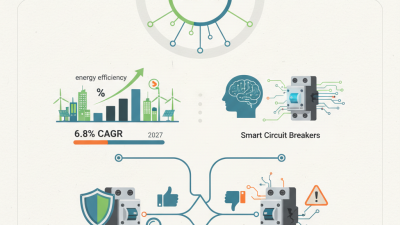
This comparison presents ten widely used miniature circuit-breaker configurations for global applications. The bar values show representative rated current, while the line shows typical short-circuit breaking capacity. B, C, and D trip curves are selected according to common IEC 60898-1 application practices: B for low inrush loads, C for general-purpose and moderate inrush loads, and D for high-inrush motors and transformers. Ratings are representative market configurations rather than brand-specific product data.

International Standards, Certifications, and Market Compatibility

Choosing a mini circuit breaker for global markets requires more than checking its current rating. International standards define safety, testing, and performance expectations. IEC 60898-1 commonly covers household and similar installations, while IEC 60947-2 applies to industrial equipment. Some markets may request UL 489, regional marks, or CB Scheme documentation. Certification must match the exact model, pole configuration, and rated voltage. A certificate for one product family may not cover every variation.

Market compatibility also depends on local electrical conditions. Check 230 V or 120 V systems, 50 or 60 Hz frequency, breaking capacity, trip curve, terminal design, and busbar spacing. A compact breaker can fit the panel physically but still fail installation requirements. In practical specification reviews, small details often cause delays. Product labels, test reports, and instruction sheets should use clear technical information. Translation quality matters too. Confusing “neutral” and “line” can create serious installation risks.

Tips: Ask for current test reports, certification numbers, and factory quality records before ordering. Confirm whether approval applies to the target country. Do not rely on a logo alone. A certificate can expire, change scope, or exclude a specific accessory. One imperfect assumption remains common: identical dimensions do not guarantee interchangeable performance. Careful comparison is slower, but it reduces rejected shipments, unsafe substitutions, and costly redesigns.

Installation, Safety Checks, Maintenance, and Replacement Guidelines

Installing a mini circuit breaker starts with confirming the circuit rating, conductor size, and available fault current. The breaker must match the distribution board and the intended load. A qualified electrician should isolate power, verify the absence of voltage, and follow the installation instructions. Tighten terminals to the specified torque. Loose connections can create heat, discoloration, and eventual failure.

Safety checks should include a firm rail fit, correct wire placement, and clear identification of each circuit. Test the breaker’s switching action before energizing the system. If the device trips immediately, do not keep resetting it. Inspect for short circuits, overloads, damaged insulation, or moisture. A test button, where provided, should operate smoothly. It is not a complete diagnostic tool. A checklist helps, but it is not magic.

During maintenance, look for burnt smells, cracked insulation, buzzing, corrosion, or unusual warmth near the terminals. Keep the enclosure clean and dry, and never spray cleaner inside it. Record repeated trips and the connected appliances; this small note can reveal a pattern. Replace a breaker after confirmed damage, unreliable operation, or exposure to severe heat or water. Use an equivalent rated replacement, not a convenient higher-rated option. That shortcut can leave wiring unprotected. Some inspections miss hidden terminal damage, so a second check is worthwhile.

xpath?