An Indoor Socket is a small, familiar part of a room, yet it carries a serious electrical responsibility. It connects appliances to a building’s wiring system through live, neutral, and protective earth conductors. When installed correctly, it delivers stable power while helping reduce shock, overheating, and fire risks. It is not merely a hole in the wall.
Brett Brenner, former president of the Electrical Safety Foundation International, has emphasized, “Never overload electrical outlets.” This practical warning explains why socket ratings matter. A phone charger uses little current, while a heater, kettle, or hair dryer can draw much more. Plugging several high-power appliances into one Indoor Socket may warm the contacts, loosen connections, or trip a circuit breaker.
The working process is simple, but not careless. Metal contacts inside the socket grip the plug pins and complete the circuit. The protective earth path helps direct fault current away from a user when a device develops an insulation problem. Shutters, covers, and residual-current protection can add further safety, depending on the design and local standards.
Small details matter. A cracked faceplate, buzzing sound, or warm plug deserves attention. Do not ignore it. Real installations are sometimes imperfect, and users may not notice hidden wiring damage. This guide explores how an Indoor Socket works, what its internal parts do, and how thoughtful selection and maintenance improve everyday electrical safety. It also questions a common assumption: familiar does not always mean safe.
What Is an Indoor Socket and How Does It Work?
Definition and Basic Purpose of an Indoor Socket
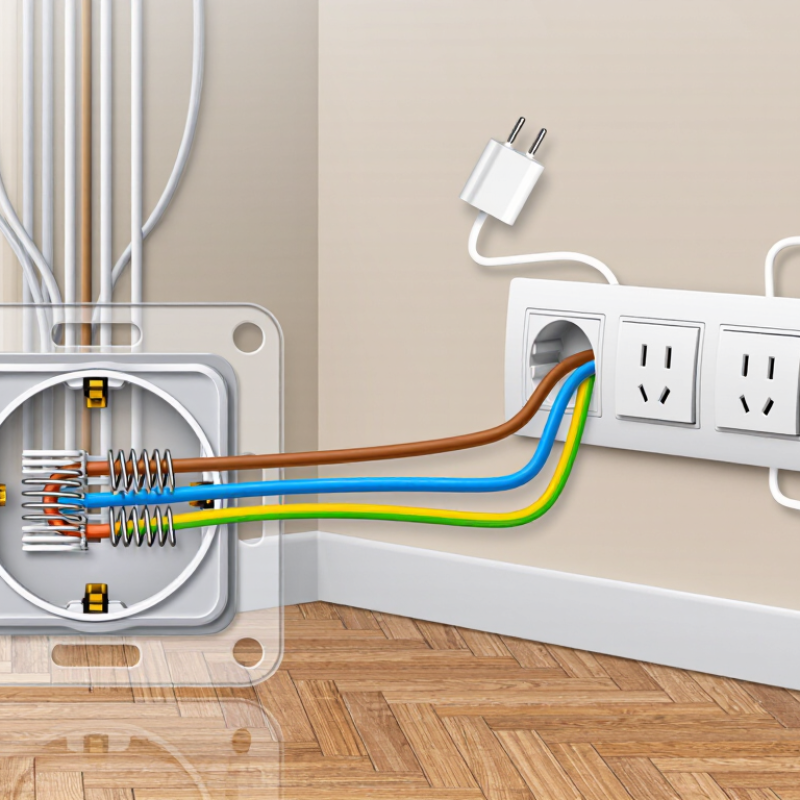
An indoor socket is a fixed electrical outlet installed inside a building. It connects a plug with the building’s wiring system. Its basic purpose is to supply electricity to lamps, chargers, appliances, and tools. Behind the faceplate, conductive contacts connect with live and neutral conductors. A protective earth path can help carry fault current away from the user. The socket does not create power. It provides controlled access to distributed electricity.
When a plug enters, its pins meet spring-loaded contacts. Current travels through the appliance and returns through the circuit. Upstream protection may include a fuse, circuit breaker, or residual-current device. These components can interrupt electricity during dangerous conditions. Requirements vary by country and installation type. IEC 60884-1 provides relevant guidance for many household socket outlets. In practice, I check for heat, looseness, discoloration, or crackling. These signs matter. A warm socket is not normal, even when the appliance still works.
The International Energy Agency reports that buildings use about 30% of global final energy. Every socket supports this larger electrical network. A National Fire Protection Association analysis of 2015–2019 data recorded an average of 31,647 annual U.S. home fires involving electrical distribution and lighting equipment. That figure deserves attention. Indoor sockets should match circuit ratings and room conditions. Kitchens, bathrooms, and workshops may require stronger protection against moisture or accidental contact. I once viewed a socket as passive hardware. That assumption was incomplete. Its contacts, enclosure, grounding, and protection devices work together, while overloaded adapters and damaged cords can still undermine safe installation.
| Data Dimension | Typical Information | Definition and Basic Function |
|---|---|---|
| Definition | A fixed electrical connection point installed inside a building | An indoor socket, also called a receptacle or outlet, provides a safe interface for connecting electrical equipment to a building's wiring system. |
| Primary Purpose | Supplies electrical power to compatible devices | When a plug is inserted, the socket connects the device's conductors to the live, neutral, and, where provided, protective earth circuits. |
| Main Conductors | Live or hot, neutral, and protective earth or ground | The live conductor delivers electrical energy, the neutral conductor completes the normal circuit, and the earth conductor provides a low-resistance path for fault current. |
| Contact Mechanism | Spring-loaded metal contacts inside the socket | The contacts grip the plug pins to maintain electrical continuity and reduce the risk of an intermittent connection caused by movement or vibration. |
| Housing and Faceplate | Insulating body with a protective front cover | The housing supports the electrical contacts and limits accidental access to energized parts, while the faceplate provides a finished and secure surface. |
| Circuit Connection | Connected to branch-circuit wiring through terminals | Conductors are secured to approved terminals, allowing power from the distribution system to reach the socket and connected load. |
| Switching Method | Switched or permanently energized design | A switched socket can interrupt power mechanically through an integrated switch; an unswitched socket remains energized whenever its circuit is supplied. |
| Common Voltage Range | Usually approximately 100–250 V AC, depending on the electrical system | The socket must match the building's nominal voltage and frequency. Voltage standards differ by country and installation type. |
| Current Rating | Common household ratings include approximately 10–20 A | The current rating indicates the maximum continuous load permitted by the socket and its circuit. The actual limit must be confirmed from the product marking and local electrical code. |
| Grounding Function | Grounded sockets include a protective earth contact | If a fault energizes an exposed metal part, the grounding path helps direct fault current to protective devices so the circuit can disconnect more quickly. |
| Safety Shutters | Available on many child-resistant socket designs | Shutters help prevent objects from entering the live and neutral openings unless compatible plug pins apply pressure in the correct positions. |
| Protection Devices | May be used with circuit breakers, fuses, or residual-current protection | Overcurrent devices protect wiring from excessive current, while residual-current protection can reduce shock risk by detecting an imbalance between current-carrying conductors. |
| Installation Location | Dry indoor areas such as rooms, offices, corridors, and workshops | Indoor sockets are intended for environments within their specified conditions. Damp, wet, dusty, or exposed locations require equipment with suitable environmental protection. |
| Socket Configuration | Single, double, or multi-position arrangements | The number of positions determines how many plugs can be connected, but the combined load must remain within the rating of the socket and branch circuit. |
| Typical Loads | Lamps, chargers, computers, televisions, and small appliances | Connected equipment draws current according to its power demand. High-power appliances may require a dedicated circuit or a socket with an appropriate rating. |
| Basic Operating Sequence | Insert plug, establish contact, draw current, remove plug | The plug pins enter the socket contacts, the circuit is completed, current flows to the device, and removing the plug separates the connection. |
| Key Safety Practice | Use compatible plugs, avoid overloading, and inspect for damage | A socket should not be used if it is loose, cracked, discolored, hot, or producing sparks. Installation and repairs should be performed by a qualified person in accordance with local requirements. |
Important: Electrical ratings, wiring methods, plug configurations, and required protection vary by country and installation. Always follow the socket markings, local electrical regulations, and qualified installation practices.