Leave Your Message

Top 10 Indoor Socket Types for Global Buyers

Choosing an Indoor Socket for an international project involves more than matching a familiar faceplate. Socket shapes, pin layouts, grounding methods, and electrical ratings vary across markets. A product that fits one wall opening may not suit another country’s wiring or connected equipment. Small differences matter.

This guide introduces ten common indoor socket types and explains what buyers should compare before requesting samples or placing an order. It covers familiar regional formats, grounded and ungrounded designs, shuttered outlets, USB-integrated models, and smart sockets. Each option has practical strengths, but none is right for every room or application. A kitchen counter, hotel bedside, and office wall have different demands.

Looks can mislead. Two sockets may appear similar while differing in rated current, supported voltage, terminal design, or installation dimensions. Buyers should check product specifications and confirm compatibility with the intended circuit and devices. For projects involving installation or uncertain wiring, consult a qualified local professional. Product documentation is useful, but it cannot replace a site assessment.

The comparisons ahead are designed to make early screening clearer, not to declare one universal winner. Some details may seem minor until a sample arrives and does not fit. That is worth remembering. Careful checks can help global buyers narrow their choices, ask better supplier questions, and select an Indoor Socket suited to the actual space and use.
Top 10 Indoor Socket Types for Global Buyers

Indoor Socket Design, Components, and Typical Applications

Indoor sockets may look simple, but their design affects fit, safety, and daily use.

Common types include grounded outlets, shuttered sockets, and combined socket-and-switch units. A socket typically contains a faceplate, insulated housing, contact clips, and screw or clamp terminals. Grounding contacts provide a path for fault current when correctly installed. Shutters help block access to live contacts, especially in homes with children.

Small details matter.

For global buyers, plug shape and voltage rating are only part of the selection.

Check the socket’s current rating, terminal capacity, mounting depth, and compatibility with the local wiring system. A deep back box can make installation difficult in a thin partition wall. Loose terminals may also overheat, so installers should follow product instructions and applicable local requirements.

The standards differ by market.

Applications vary by room and building.

Residential bedrooms often use standard grounded outlets near beds and desks, while kitchens may need higher-rated units suited to appliance loads. Offices can benefit from sockets with USB charging, but these add electronic components that should be checked for heat management and service access. Bathrooms and other damp locations require suitable protection and professional installation.

The faceplate is visible; the quality of the connections is less obvious. That is easy to overlook.
Regional Plug Standards and Socket Compatibility

Indoor socket compatibility begins with geography, but wall shape is only the first clue. Type A/B is common in North America and Japan; Type G is used in the UK, while Type I serves Australia and parts of Asia. Variants exist within regions. A universal inlet does not guarantee safe grounding or a secure fit. Fit is not safety.

IEC 60884-1:2022 covers household plugs and socket-outlets rated up to 440 V AC and 32 A. These figures define the standard’s scope; they do not mean every local outlet supports those ratings. Check the appliance nameplate against local voltage and frequency, and confirm earthing requirements. A travel adapter changes the plug shape, not the voltage. Compatibility charts can oversimplify country differences, so verify the exact destination standard before selecting sockets.

Tips: Photograph the outlet and appliance label before ordering. Check plug type, voltage, frequency, and grounding together. A small mismatch matters.

Top 10 Indoor Socket Types for Global Buyers

Typical plug current ratings by regional standard (amperes)

Ratings shown are common standard ratings; some plug types have variants with different limits. A matching plug shape does not guarantee electrical compatibility—check voltage, frequency, grounding, and local requirements before use.

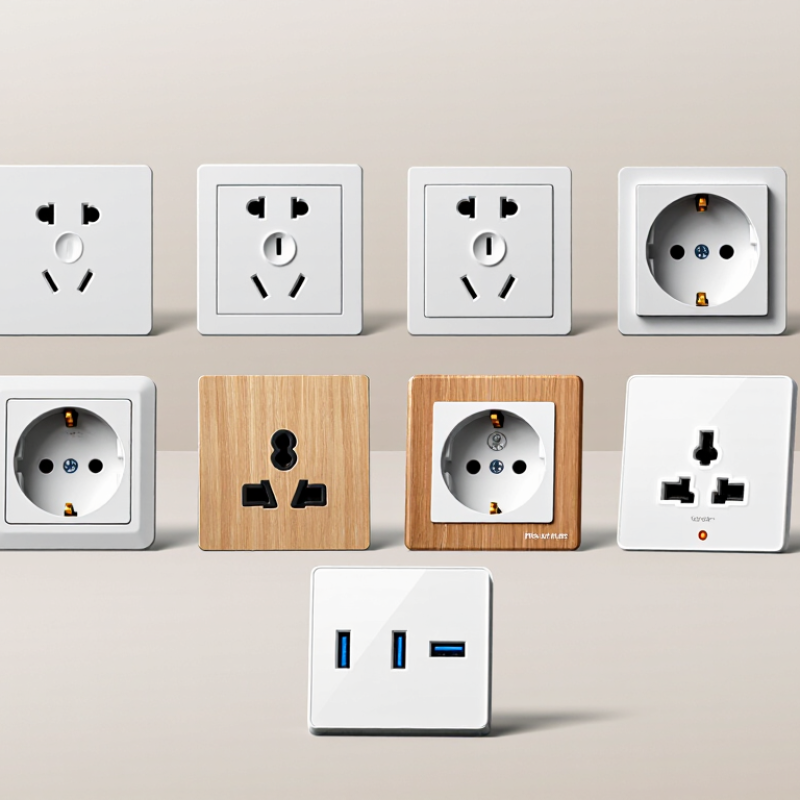
Ten Common Indoor Socket Types in Global Markets

Indoor sockets are not interchangeable, even when plugs look similar. Type A uses two flat pins, while Type B adds a grounding pin. Both appear across parts of the Americas and Asia. Type C has two round pins and is common in many European markets. It is compact, but generally lacks an earth connection. Type D uses three large round pins, especially in India and some neighboring markets. Type E has a grounding pin in the socket; Type F uses side grounding contacts. Both are widely found in continental Europe.

Type G has three rectangular pins and is common in the United Kingdom and several other markets. Type I uses angled flat pins in Australia, New Zealand, and China. Type J has three round pins, with a distinct arrangement used in Switzerland and Liechtenstein. Type L places three round pins in a straight line and is associated with Italy. Small details matter. Socket depth, shutter design, grounding, and rated voltage can differ between products. The labels are not perfectly tidy: hybrid sockets and local variants complicate simple charts. Buyers should confirm the destination’s plug pattern and electrical ratings before specifying indoor outlets. A plug that fits is not necessarily a safe match.

Key Differences in Safety Features and Socket Configurations

Indoor sockets differ in contact layout, grounding, shutters, and plug retention. Type A and B sockets are common in parts of the Americas; Type B adds a grounding contact. Type C has two round pins and no earth connection, while Type E and F designs provide grounding through different contact arrangements. Type G uses rectangular pins and often includes internal shutters. Type I, J, K, and L configurations also vary in pin shape and grounding position.

Small details matter. A grounding contact can support a protective path, but only when the installation is correctly wired. Shutters may reduce access to live contacts, though their design and operation vary. Some sockets include switches; others rely on separate circuit controls. Type alone does not confirm voltage compatibility, grounding quality, or protection against electric shock. Looks can mislead. When comparing indoor sockets, check rated voltage and current, terminal design, required protection features, and recognized local certification. A practical inspection should also confirm that plugs fit firmly without wobbling. Global buyers should verify the destination market’s requirements with a qualified electrical professional; product descriptions do not always explain installation limits clearly.

How to Select Indoor Sockets for Different Locations and Devices

Choose indoor sockets by location, plug shape, and the devices you use—not by appearance alone. In a kitchen, grounded sockets near work areas suit small appliances, but keep them away from sinks and splashes. A home office may benefit from sockets with USB charging, while a bedroom often needs outlets reachable beside the bed. Check the device label and local voltage, current, and plug requirements before buying. These details vary by market.

Tips: Measure furniture clearance before installation. Leave space for bulky adapters. Avoid overloading sockets or connecting multiple extension strips. For damp areas or uncertain wiring, ask a qualified electrician about suitable placement and protection.

In living rooms, consider where lamps, televisions, and floor cleaners will actually sit. A floor socket can reduce trailing cords, but it needs careful positioning to avoid rugs and foot traffic. Smart sockets may help control compatible lamps, yet they do not make an overloaded circuit safe. Small details matter. I have found that even a tidy layout can miss one awkward plug behind a cabinet, so mark furniture positions before choosing outlet locations. Check that sockets are accessible and securely installed, and use products approved for your region.

Top 10 Indoor Socket Types for Global Buyers – How to Select Indoor Sockets for Different Locations and Devices

Socket Type Typical Locations Common Electrical Supply Grounding and Contact Details Suitable Indoor Uses Buyer Selection Checks
Type A Japan, the United States, Canada, Mexico, and parts of Central America Commonly 100–127 V; frequency varies by country and, in Japan, by region Two flat parallel pins; generally ungrounded. Some versions are polarized. Small appliances and electronics designed for the local supply, such as lamps, chargers, and radios Check plug polarization, socket rating, and device voltage. Do not assume a two-pin outlet provides grounding.
Type B Japan, the United States, Canada, Mexico, and parts of Central America Commonly 100–127 V; frequency depends on the country and local grid Two flat parallel pins plus a grounding pin; commonly used on grounded circuits. Grounded household appliances, computers, and other equipment with compatible plugs Confirm the circuit and receptacle are properly grounded, and match the outlet rating to the appliance load.
Type C Widely used across continental Europe and in many countries in Asia, Africa, and South America Commonly 220–240 V, 50 Hz in many locations; local supply can differ Two round pins; the plug itself has no grounding contact. Socket compatibility depends on the local design. Double-insulated, low- to moderate-power devices with a compatible two-pin plug Check whether the specific socket accepts the plug size and pin spacing. Use a grounded socket for appliances that require earth.
Type D India, Nepal, and some nearby locations Commonly around 230 V, 50 Hz Three round pins in a triangular layout; commonly associated with a 5 A plug system. Compatible small and medium household appliances intended for the local system Verify plug dimensions and current rating; do not assume compatibility with other three-round-pin systems.
Type E France, Belgium, Poland, the Czech Republic, and other locations using this system Commonly around 230 V, 50 Hz Two round pins with a grounding pin in the socket; the socket is designed for compatible grounded plugs. Grounded household appliances and general-purpose indoor outlets Check that the plug has the matching earth-contact arrangement and that the outlet is correctly installed and rated.
Type F Germany, Austria, the Netherlands, Spain, and many other European locations Commonly around 230 V, 50 Hz Two round-pin openings with grounding clips on the sides; commonly rated up to 16 A, subject to local rules. Grounded household appliances, office equipment, and general indoor use Confirm side earth contacts are present and compatible. Check the socket’s current rating and installation requirements.
Type G United Kingdom, Ireland, Malta, Cyprus, and several other locations Commonly around 230 V, 50 Hz Three rectangular pins; commonly used with a fused plug system, often rated up to 13 A. Most compatible household appliances and electronics when the plug fuse and circuit are correctly selected Check the required fuse rating, shuttered-socket requirements, and local wiring regulations.
Type I Australia, New Zealand, China, and Argentina, with local variations Commonly around 220–240 V, 50 Hz; national specifications may vary Two angled flat pins; grounded versions add a vertical earth pin. Plug and socket ratings vary by location. Compatible locally rated appliances, including grounded equipment when a matching grounded outlet is installed Check pin orientation, earthing, and the applicable local rating; similar-looking versions may not be interchangeable.
Type J Switzerland and Liechtenstein Commonly around 230 V, 50 Hz Three round pins in a triangular arrangement; small two-pin plugs may fit some compatible sockets but do not provide grounding. Swiss-system household devices and compatible two-pin, double-insulated equipment Check the plug’s pin size and grounding needs. Use an earthed outlet for appliances that require a protective earth.
Type L Italy, San Marino, Vatican City, and some nearby locations Commonly around 230 V, 50 Hz Three round pins in a line; 10 A and 16 A versions use different pin dimensions. Compatible local appliances and devices matched to the socket’s specific current rating Identify the 10 A or 16 A version before purchase; do not rely on appearance alone for compatibility.

Electrical values and compatibility can vary by country, installation, and product rating. Select sockets according to local electrical codes, voltage, frequency, current capacity, grounding requirements, and the exact plug design. A plug adapter changes physical fit only; it does not convert voltage or frequency.